
Crash Games Casino

Hi-Lo
Crash

Hi-Lo Review: Turbo Games Card Game

by Turbo Games

Hi-Lo
Hi-Lo
Hi-Lo
RTP
95.00%
Risk level
—
Maximum payout
—
Reel grid
—
Winning ways
—
Launch date
04/04/2023

27/09/2026 Published 04/10/2026 Revised

Hi-Lo Trades the Card Table for Crash Mechanics

Two RTP figures travel with Hi-Lo: the rules booklet inside this build prints 95.0%, while the Turbo Games storefront advertises 97%. The in-game number is the one that governs play, and it sets the terms for everything else. Mechanically this sits in the crash family rather than at the card table: the stake is debited at the first revealed card, each correct higher-or-lower call on the next card lifts a Progressive Multiplier, and the Cash Out button banks the printed value at any step, with one wrong call forfeiting the round. Those multipliers are not a running product; they are recomputed from the odds of the card currently showing and posted before a guess is committed, an Equal option near x20 standing in for the impossible direction on a 2 or an Ace. Autoplay and seed verification are absent from this build, so pacing stays entirely manual.

Hi-Lo Review: The Round Begins at the First Card, Not the Button

Commitment Is Free Until the First Card

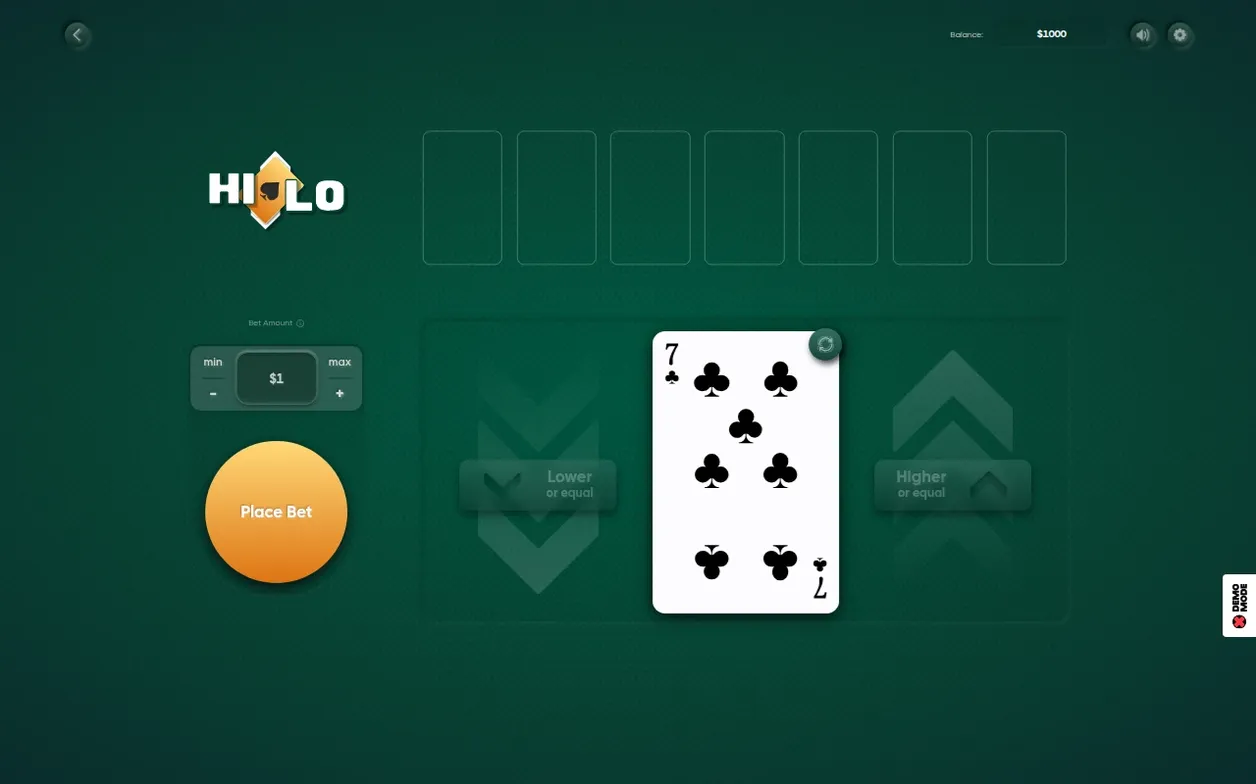
Clicking Place Bet in Hi-Lo costs nothing. The stake leaves the balance only when the first card of the round is revealed: the recorded balance drops from $1000 to $999 at that moment, while a Cancel click before any reveal is documented with the balance unchanged at $995.55. The split matters because it separates decision from charge. Until the first reveal, the rules let the player randomise the starting card and walk away without penalty; after it, the stake is spent regardless of what follows, and a losing guess takes nothing further. Turbo Games builds the round so that its point of no return is a card, not a button, a timing choice already documented in other titles from the same provider.
Every Price Is Printed Before It Is Paid

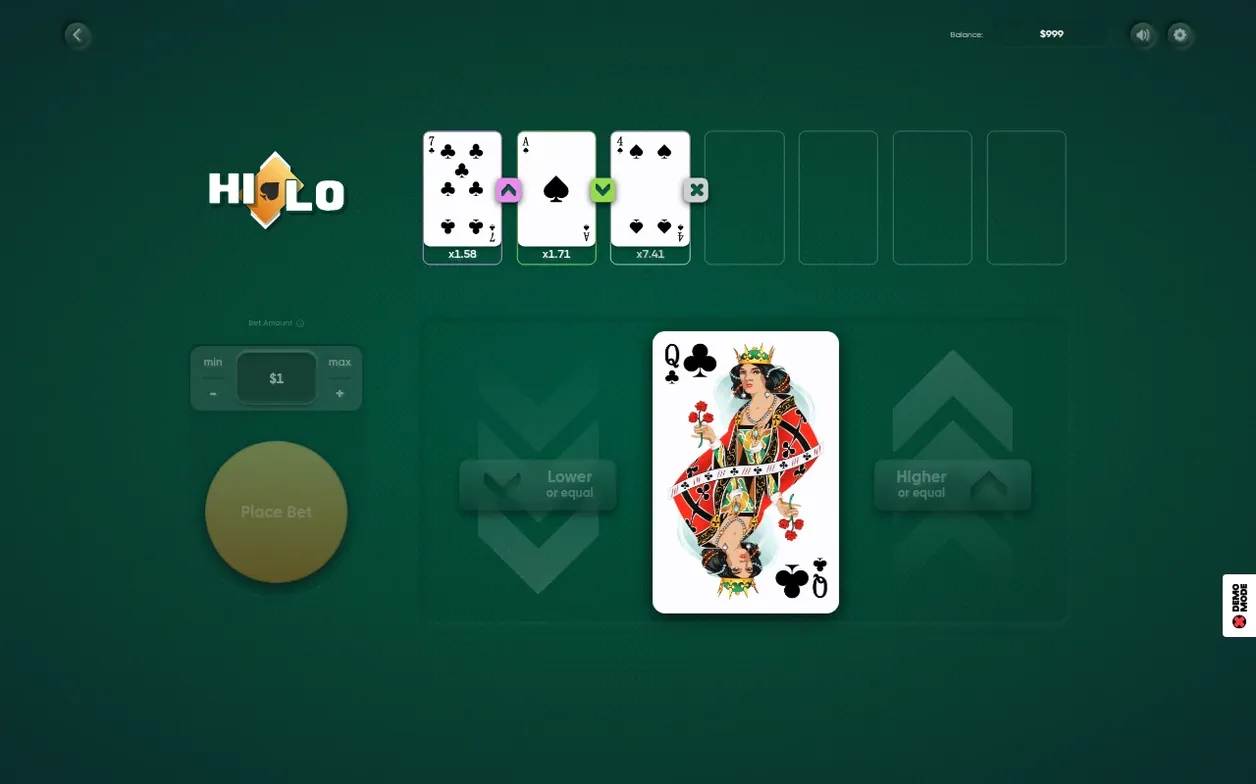
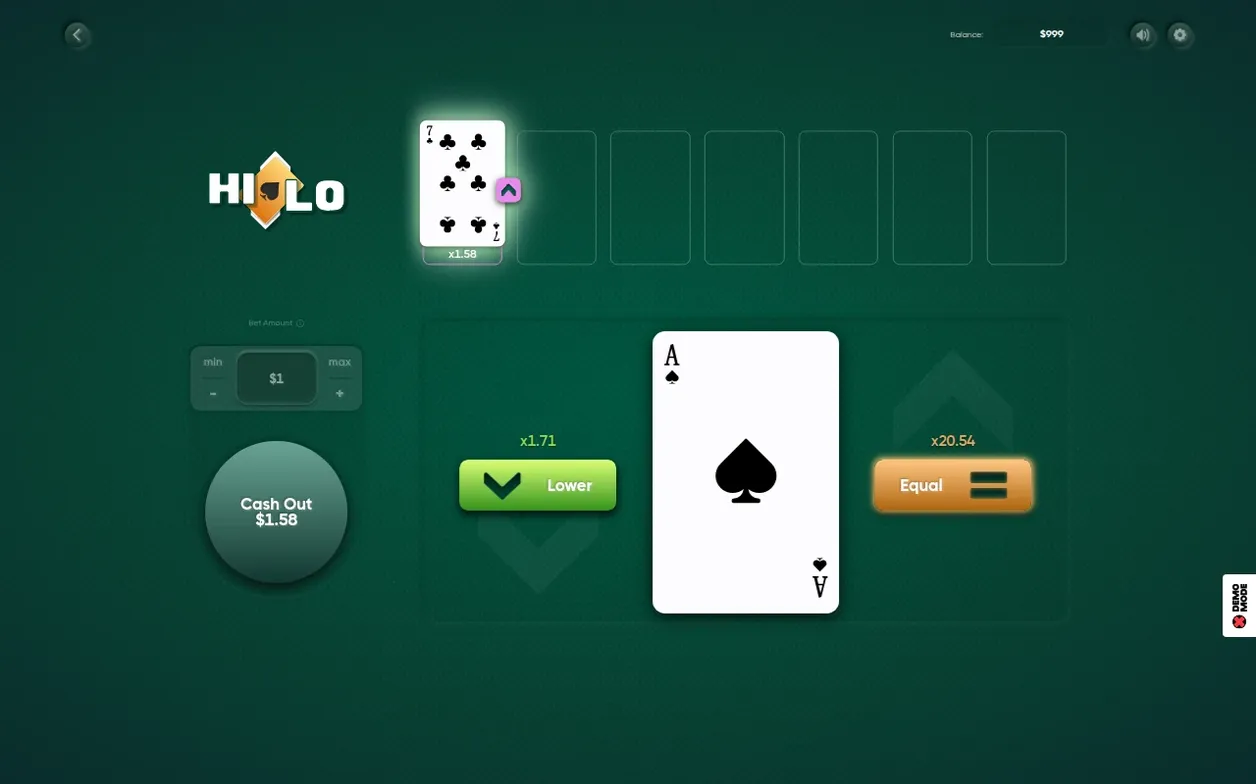
Once a round is live, the table quotes the cost of each move before the move exists. With a 7 showing, Lower pays x2.1 and Higher pays x1.58; with an Ace, the impossible direction is replaced by an Equal option quoted at x20.54 against Lower's x1.71. These are absolute payout multipliers for the single next guess, recomputed from the live card each time, so the x1.58 on the Cash Out button after two correct guesses is a current state, not a running product. The Progressive Multiplier grows without a clock: nothing rises on its own and nothing times out, and the round advances only on an explicit click. Cash Out arms after the first correct guess and pays stake times the printed figure, verified twice by balance delta ($1 at 1.15x returned $1.15; at 1.40x, $1.40) and a third time in the My bets table. At every step information precedes commitment, the inverse of a crash curve that must be chased.

A Win Gets a Banner; a Loss Gets Nothing

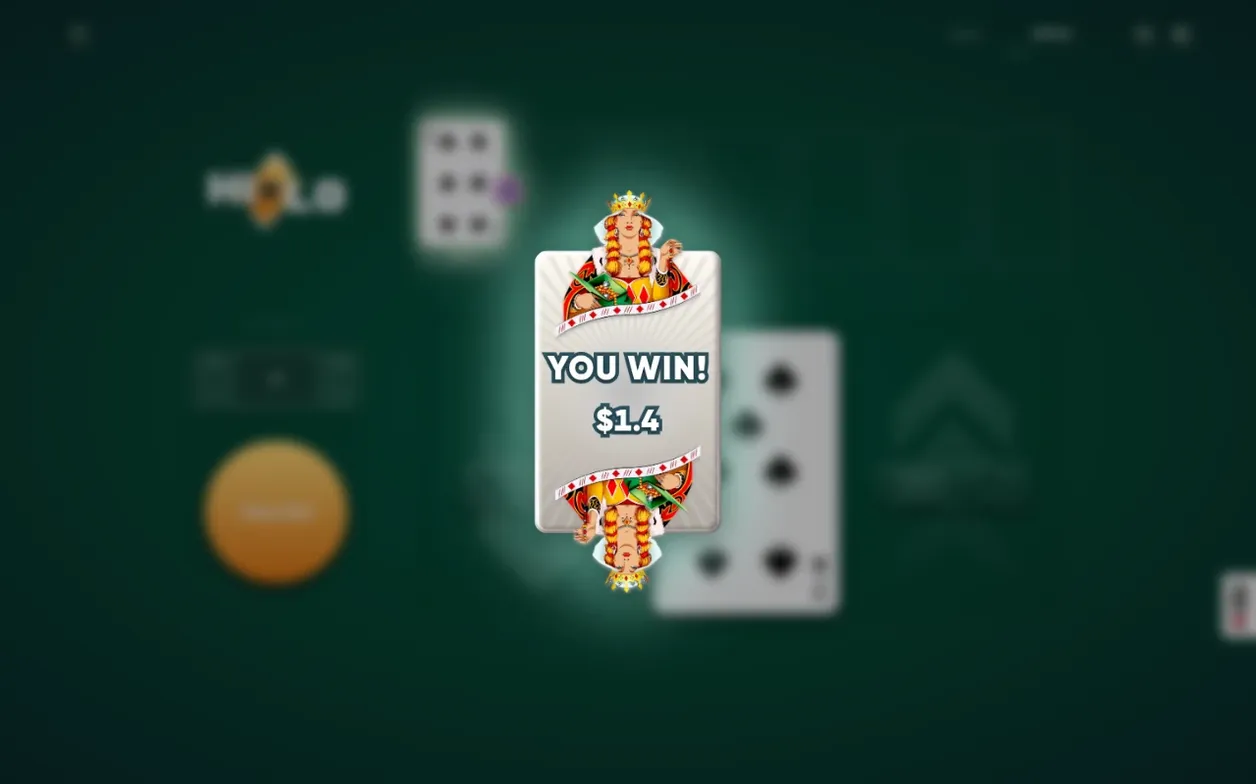
The two ways a Hi-Lo round can end are treated unequally. Cashing out summons a full-screen panel: a crowned queen on an oversized ceremonial card, the table blurred behind it, the payout printed beneath a YOU WIN heading. A wrong guess produces no banner at all. Across three separately captured losses the table simply resets to the Place Bet state, the failed card marked in the history row with a grey badge and an X, and everything the round accumulated is forfeited. The durable record lives elsewhere, in the My bets table, where losing rounds persist as 0.00x rows beside the 1.15x and 1.40x wins. One temporal gap stays open: the rules call reveals unlimited, yet the history row holds exactly seven slots, and no captured round passed three, so what the row does beyond a seventh card is unrecorded.

The Booklet Prints Less Than the Storefront Promises

PropertyPrinted in this buildAdvertised elsewhere
RTP95.0% in the rules booklet97% on the Turbo Games storefront
Max multiplierNo ceiling printed in any rules sectionUp to x999999 on the storefront
Provably fairNo seed, hash or verify control foundAdvertised on the storefront
Bet limitsMin $0.1, max $100, max profit $10000No comparable claim recorded

Playing smart: bankroll and volatility

Every Hi-Lo guess is priced on screen before it is committed, and every correct one builds a Cash Out sum that one miss will void. Inside a round, two choices shape the result: which direction to back at the printed odds, and when to bank the Progressive Multiplier rather than chase a recomputed one.

  1. Cash Out versus one more guess

    The Cash Out circle pays stake times the multiplier shown at the click, a figure verified against balance records and the My bets table. Pressing it locks that sum; guessing again risks the whole amount, and a miss forfeits it, though no further money leaves the balance. What the next step pays is unknowable, since the Progressive Multiplier is recomputed from the card dealt next.

  2. Lower, Higher or Equal at printed odds

    Each direction pill prints its resulting multiplier before anything is committed, computed from the live card's odds: a likely small step or a rare large one. On a 2 or an Ace an Equal pill replaces the impossible direction, observed at x20.54 on an Ace. Whether revealed cards shift those odds is undocumented; the history row gives no proven information about the next deal.

How the symbols pay out

Win banner shows illustrated queen card, text YOU WIN! and $1.4 payout over blurred green table.
Reel symbol Symbol role
Numeral Cards (2-10) Other
Face Cards (Jack, Queen, King) Other
Ace Other

How to place a bet

Hi-Lo deals a single card face up and asks one question: will the next card be higher or lower? Every correct call grows the Progressive Multiplier and repeats the same choice - Cash Out to bank the winnings, or guess again. One wrong call forfeits the stake.

Set stake, Place BetEnter a stake in the Bet Amount field; the small refresh icon on the card panel swaps the starting card while no bet is placed. Click Place Bet to deal the first card face up and light the Lower and Higher pills with their multipliers.
Guess and Cash OutPick Lower or Higher; on a 2 or an Ace, Equal replaces the impossible guess. A correct call files the card into the history row and updates the Cash Out value, which pays stake times the printed multiplier. Collect it, or guess again - a miss ends the round and forfeits the bet.

Game modes

Idle Hi-Lo table: 7 of Clubs showing, empty history slots, Lower and Higher buttons, orange Place Bet circle, $1000 balance.

Hi-Lo builds each round on a single revealed card: every correct higher or lower call raises the Cash Out value, and one wrong guess ends the round and forfeits everything accumulated.

  • Base Game

    A round opens on Place Bet, but the stake is debited only when the first card is revealed; until then Cancel is free. Each correct higher or lower call moves the live card into the history row, turns the button into Cash Out, and recomputes its multiplier fresh from the new card's odds. On a 2 or an Ace, an Equal option replaces the impossible direction. Cashing out pays stake times the displayed multiplier; one wrong guess ends the round and forfeits the accumulation.

Special symbols and features

Cash Out, Progressive Multiplier

Theme and setting

Card games

Studio behind the game

Turbo Games

Turbo Games builds crash and instant-win rounds rather than reel slots: Crash X, Mines, Aero, Turbo Plinko and the Vortex series are all single-round formats settled by cash-out or fixed payout. Each round runs on a seed-based provably fair mechanism, letting a player check the outcome after settlement, and many titles hand risk control to the player through grid size, mine count or a win-chance slider. The catalogue mirrored here runs from 2021 to 2026, including a recurring Cricket Arena series. Turbodev OU, the company behind the studio, is registered in Estonia and appears in the Malta Gaming Authority Recognition Notice register as a B2B critical supply provider.

Compatibility

Autoplay option
No

Betting options

Starting bet
0.10
Max bet allowed
100.00
Currency of bets
USD
Bets per round
1

Our take

ProsEvery guess shows its exact payout multiplier before you commit, so the risk of each step is priced on the live card.
ProsCancel is free until the first card is revealed, so the stake leaves the balance only once a round truly starts.
Where it falls shortThe build prints RTP 95.0% against a storefront-advertised 97%, and the lower in-build figure is the one that governs.
Where it falls shortNo provably fair seed or hash check exists in this build, so rounds cannot be verified independently by the player.

Hi-Lo turns the crash loop into single-deck card calls: the multiplier curve is replaced by per-card odds, and cashing out after any correct guess keeps the same nerve test. It suits players who want transparent step pricing and manual control; those expecting seed verification, autoplay or the advertised 97% will find this build short.

Got questions? We have answers

How does a round of Hi-Lo by Turbo Games play out?

One card is dealt face up, and the player predicts whether the next card will be higher or lower; 2 is the lowest rank and Ace the highest. Each correct guess raises the Progressive Multiplier, and Cash Out becomes available after the first correct guess. One wrong guess ends the round and forfeits everything accumulated in it.

What is the RTP of Hi-Lo?

Hi-Lo prints an RTP of 95.0% in its own rules booklet, and that is the figure that counts for this build. Turbo Games' storefront advertises 97% for the same title, a marketing number that does not match the game itself. RTP is a statistical average over billions of rounds, not a per-round promise.

How is a Hi-Lo payout calculated at cash out?

The payout is the stake multiplied by the figure printed on the Cash Out button at the moment it is pressed. Example: a $1 stake cashed at 1.15x returns $1.15; cashed at 1.40x it returns $1.40. Cash Out opens after the first correct guess, and holding longer raises the amount while the whole stake stays at risk.

Do the step multipliers in Hi-Lo multiply into each other?

No. The number under each history card and on the Cash Out button is the current absolute multiplier, recomputed from the odds of the live card, not a running product of earlier steps. Before each guess the game prints fresh Lower and Higher values for the next card, so 1.58x after two guesses is that card's price, not 1.05 times 1.10.

When does the Equal option appear in Hi-Lo?

Only on the two extreme ranks, 2 and Ace, where it replaces the direction that cannot exist: nothing sits lower than a 2 and nothing higher than an Ace. Equal is the riskier call with a far larger price; on an Ace the game prints Equal at x20.54 against x1.71 for the Lower guess.

When does Hi-Lo take the stake from the balance?

At the first revealed card of the round, not at the click of Place Bet. While that first card is still showing and no guess has been made, the bet can be cancelled free of charge and the balance stays unchanged. From the first reveal onward the stake is committed, and a losing guess deducts nothing further.

What are the bet limits and top payout in Hi-Lo?

Stakes run from $0.10 to $100 per round, and one round's profit is capped at $10,000, both printed in the Limits panel and on the bet field's max tooltip. No maximum multiplier is stated anywhere in this build's rules, so the cash ceiling is the only confirmed upper bound on a win.

Does this Hi-Lo build include autoplay or provably fair tools?

Neither appears in this build. The settings panel holds only a nickname field, limits, rules, a recent-bets list and two volume sliders, and the rules booklet mentions no autoplay mode. Provably fair is advertised on Turbo Games' storefront, but no seed, hash or verification tool is present in the game itself.

Available at

  1. 1XBET Registration alone unlocks a $10 credit, no payment needed. Winnings from it cap at $100 and clear after wagering the amount twenty times within seven days; verify a phone number first, and any balance above the ceiling is removed before withdrawal. Visit casino
18+

Casino links here are sponsored partnerships.

Enjoyment first, income never — decide how much you can afford to spend before starting.

Start playing for real stakes