Crash Games Casino

Mines
Crash

Mines: How the Crash Game Works

by InOut Games

Mines
Mines
Mines
RTP
95.00%
Risk level
—
Maximum payout
4,940,284x
Reel grid
—
Winning ways
—
Launch date
09/11/2023

10/09/2026 Published 01/11/2026 Revised

3 Bombs stretch Cash Out; 24 Bombs end it

InOut Games’ Mines sets a 4940284 max win beside a 20000 USD payout cap, so the top of the ladder is arithmetic before it is money. That tension is the build: the bomb count is the sequence. At 3 Bombs the Prize Ladder runs through 22 small steps from x1.07; at 24 Bombs one hit at x23.75 ends the round. Variable volatility is pacing here, not a label: fewer bombs stretch the Cash Out decision across clicks, more bombs compress it into one step under the cap. The 95.00% RTP fits that curve.

Mines documents the round in front of you, not its own ceiling

The decision surface, mid-round
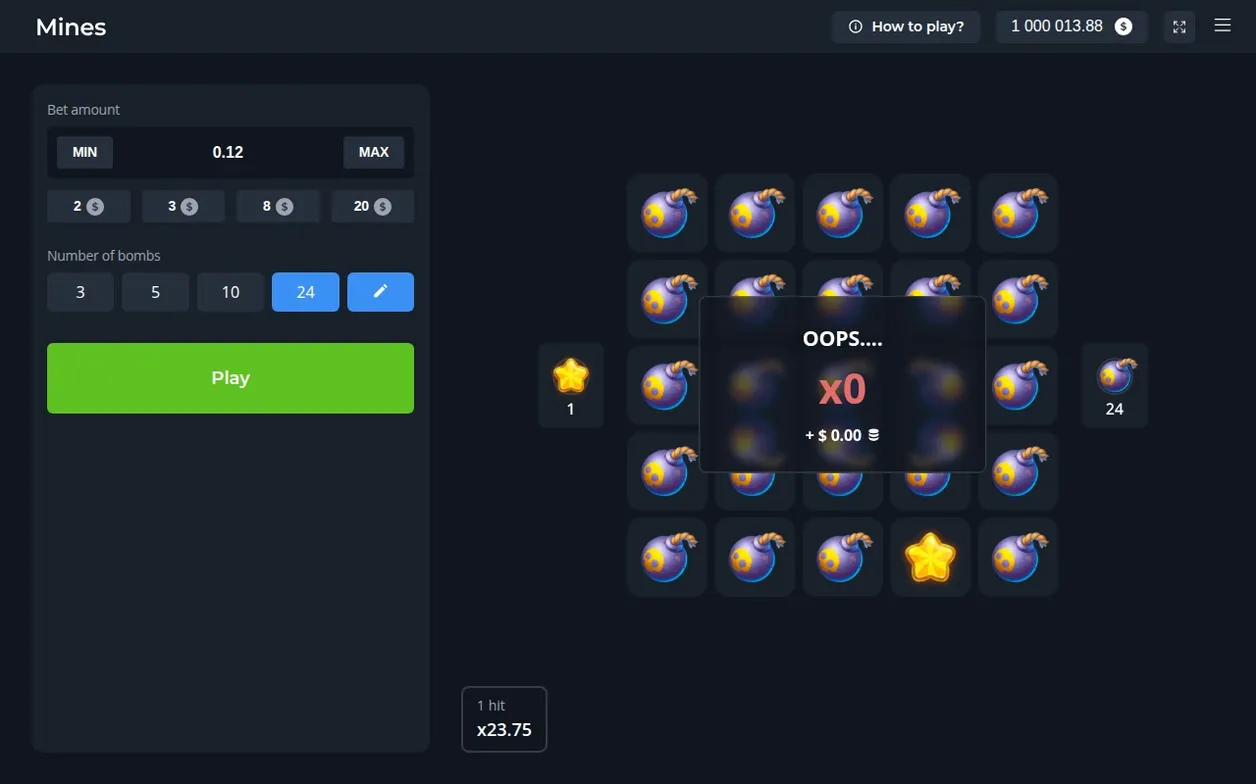
Revealed 5x5 grid at 24 bombs shows OOPS, x0, +$0.00 after hitting a bomb; one star found

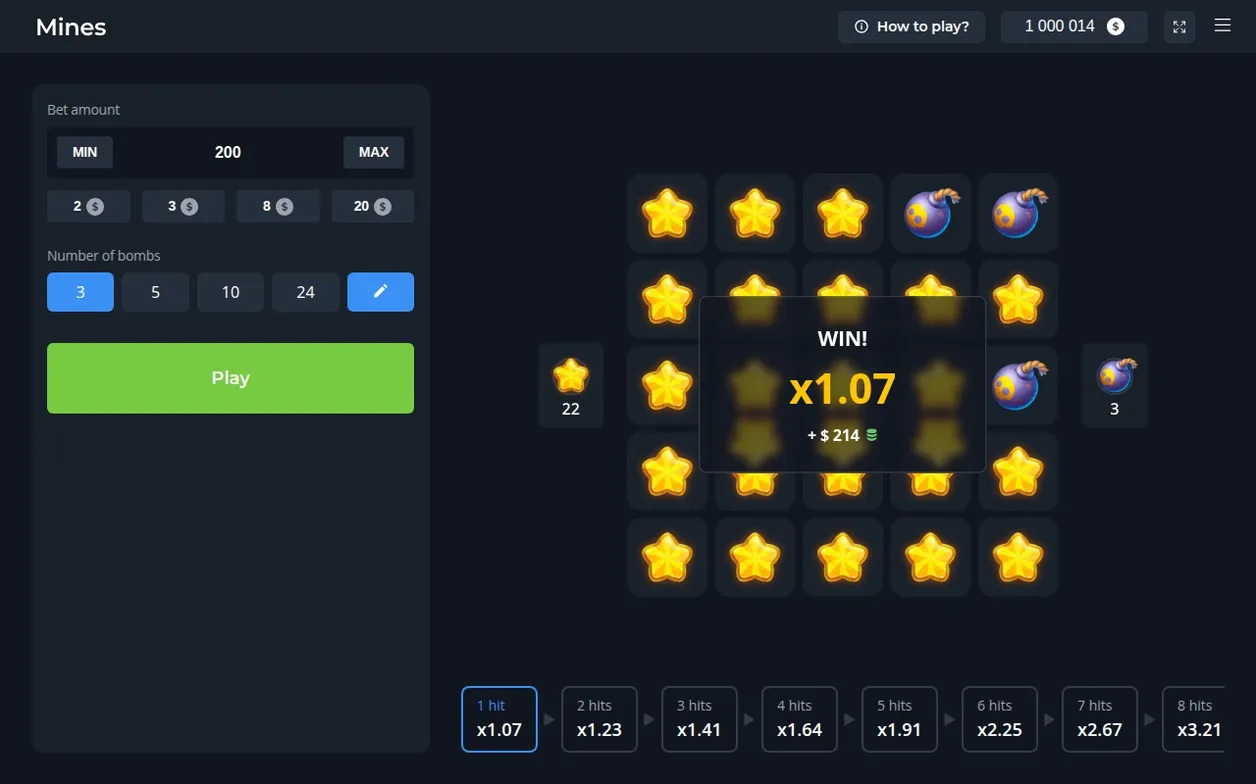
One star into a round at 200 USD on three bombs, the green button reads Cash Out $ 214 and the first ladder card, 1 hit x1.07, carries the blue outline. The numbers that decide the next click sit in one vertical glance: 21 stars still hidden on the board's left, 3 bombs on its right, and the exact dollar figure on the Cash Out button itself. Bet controls grey out for the duration, so the screen stops offering choices it will not honour. The end of a round is stated the same way, in words and shapes rather than colour: a win prints a WIN banner with a golden multiplier and the payout; a bomb prints an OOPS banner with x0 and + $ 0.00 while every cell flips face-up. The single review frame catches that failure state, the OOPS overlay and loss figures laid over the full panel. A player who cannot read red still reads the result.
The ladder is the risk statement

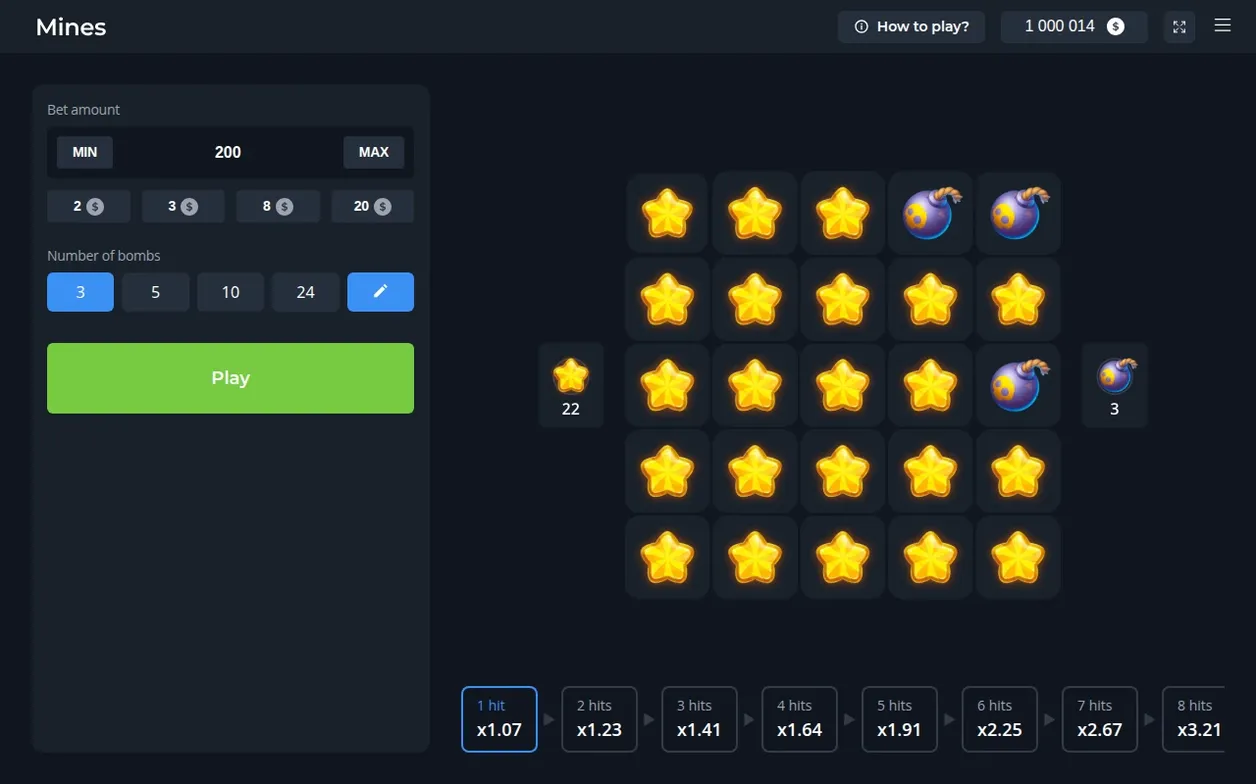
Variable volatility here is not a label but a rewriting. Each bomb preset rebuilds the Prize Ladder from scratch: 22 steps at 3 bombs starting at 1 hit x1.07, 15 steps at 10 bombs starting at x1.58, and a single card, 1 hit x23.75, at 24 bombs where the counter reads 1 star against 24 bombs. The player chooses how much ladder to buy before the first click, and the strip then behaves like a debt clock run in reverse. The hierarchy holds because the choice and its cost stay adjacent: preset buttons with the selected one filled blue, a pencil button that accepts any count from 1 to 24 and clamps 25, and a strip that shortens as the first-step multiplier climbs. There is no auto cash-out and no autoplay, so the pacing of disclosure, one cell at a time, belongs to the player. What the ladder never says is what a step is worth in money until the button says it; the strip prints multipliers only.

Past the visible edge, the record thins

The same hierarchy thins past the visible edge. The ladder strip is cut off at the right of the screen after roughly eight cards, and its deep tail survives only as page text the capturer read, not as anything on a kept frame: the printed 50473.49 at 5 bombs and 20 hits, x4 940 284.99 at 12 bombs and 13 hits. Return is derived, never printed: six checked ladder points fit a 0.95 return and none fits 0.96, the figure the provider card prints for this game. The printed 20,000 USD max win binds long before the ladder top, leaving a money ceiling of about x166,667 at the 0.12 minimum bet, so the advertised ceiling and the enforced ceiling contradict each other and neither is a single reachable maximum. Even the provably fair panel truncates the next server seed SHA256 inside its field; per-bet checks with the green shields in bet history remain the only complete verification path. The build documents the present round well and its own ceiling poorly.

Playing smart: bankroll and volatility

Two decisions are the player's own: the bomb count set before Play, and when to stop opening cells. The first fixes the prize ladder's rungs — higher steps over a shorter climb — while the derived return stays level. The second decides whether the climb is banked through Cash Out or lost to a bomb. Neither makes the next cell more knowable; they set what is risked and when it is kept.

  1. Bomb count sets the climb's shape, not its return

    Before Play, the presets or the pencil field (1 to 24; typing 25 clamps to 24) set the bomb count, which fixes the prize ladder's length and the value of every rung. Higher counts pay more per hit over fewer rungs. The printed values price each step's risk, so the derived return is 95% at any count; only the climb's shape changes. Bomb positions stay unknown each round.

  2. Cash Out banks the climb; the next cell risks it

    Once a star is open, Cash out $ amount banks bet times the current multiplier and ends the round. Every further cell reopens the same decision one rung higher: the next multiplier, or a bomb that ends the round at x0 and pays nothing. The next cell is unknowable; results come from the game's provably fair seeding and can be verified in bet history.

How to place a bet

Mines turns a 5x5 field into a cash-out race: pick a bomb count and bet, press Play, then open cells one at a time. Each star moves the multiplier up the ladder; any bomb ends the round at x0, while Cash Out banks the current prize.

Set bombs and bet, then PlayIn the left panel, choose under Number of bombs: preset 3, 5, 10 or 24, or open the pencil button for a custom bomb count. Set Bet amount with MIN or MAX, then press Play; the board shows 25 closed cells and greys out the bet controls.
Open cells and resolve the roundClick closed cells one by one. A star opens dark slate, moves the blue ladder highlight to the next hits card and changes Play to Cash out $ amount; pressing Cash out pays bet times that multiplier and completes the cycle. A bomb reveals every cell at x0 and ends the round; after a star, continuing repeats the same branch.

Game modes

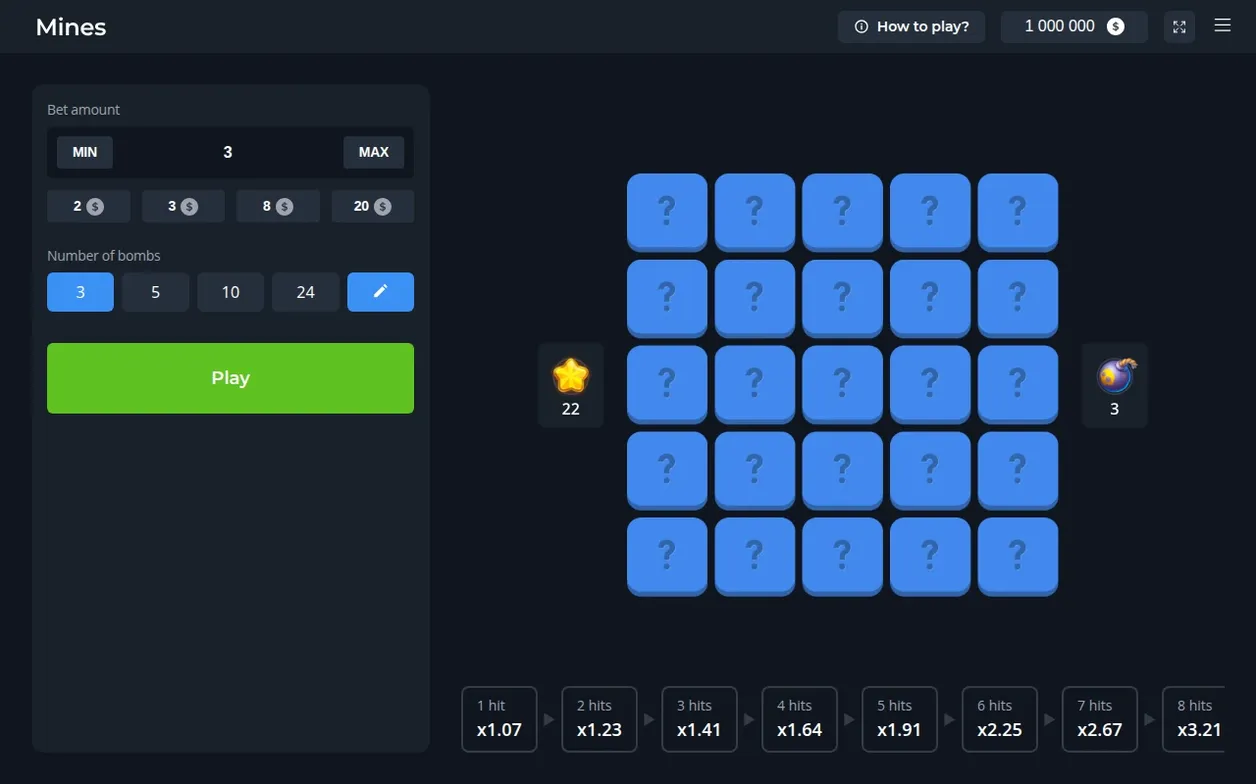
Board at 3 bombs reveals stars and bombs with ladder steps 1 hit x1.07 through 8 hits x3.21

All five controls set the bomb count before Play, and the count rewrites the whole prize ladder: it fixes how many of the 25 cells hide stars, how many steps the ladder runs, and what each hit pays. More bombs raise every step but shorten the climb.

  • 3 Bombs

    The lowest preset: three of the 25 cells hide bombs, 22 stars remain, and the ladder runs all 22 steps, from 1 hit x1.07 to 3 hits x1.41. It pays the smallest per-hit multipliers and offers the longest climb.

  • 5 Bombs

    Two more bombs than the lowest preset cut the ladder from 22 steps to 20 and raise every multiplier: five bombs leave 20 stars, each opened cell is riskier, and the climb is shorter.

  • 10 Bombs

    Ten bombs leave 15 stars and stop the ladder at 15 steps, where each step pays more than the matching step at five bombs. The ordering holds across presets: more bombs, higher multipliers, fewer rungs.

  • 24 Bombs

    The extreme preset puts 24 bombs among the 25 cells and hides a single star. The ladder collapses to one step, 1 hit x23.75; once that star is open there is no next rung, only cash out or a bomb.

  • Custom Bomb Count

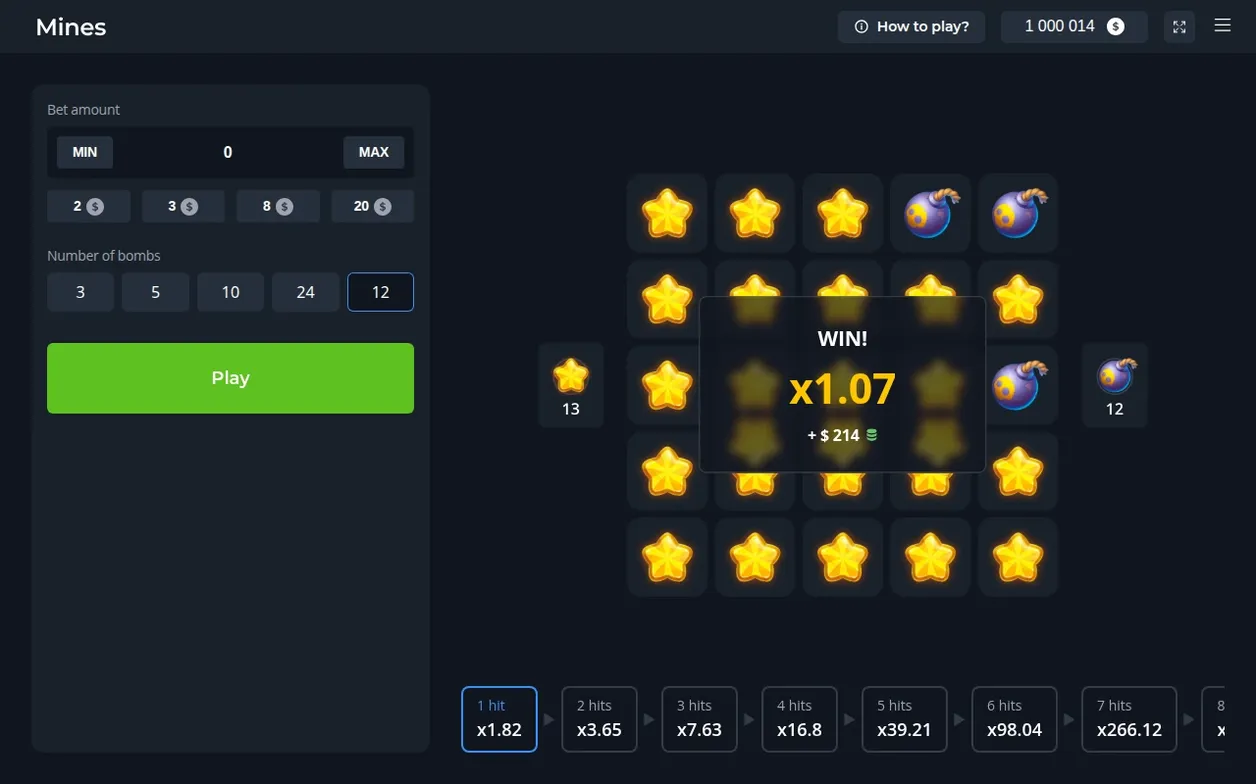
    The pencil button opens keyboard entry for any count from 1 to 24; typing 25 clamps to 24. The typed count rewrites the ladder exactly like the presets: at 12 bombs, 13 stars hide and the ladder opens at 1 hit x1.82, then 2 hits x3.65 and 3 hits x7.63.

What bonuses are on offer

Buy-a-bonus
No

Special symbols and features

Cash Out, Prize Ladder, Variable volatility

Studio behind the game

InOut Games

Chicken Road is InOut Games' signature line, but crash mechanics dominate its output: over half the studio's catalogue in this mirror falls into that category, alongside instant-win titles, a smaller run of video slots and a handful of table games. Titles are HTML5-based, localised into more than fifteen languages and built for multiple currencies, which suits distribution through aggregation partners such as Hub88, Slotegrator and Infingame. The site and games are operated by IOGr B.V. under an Anjouan B2B licence, supplying platform and back-end services to licensed operators. Recent releases keep iterating on the crash format with layered features like level progression, variable volatility and cash-out mechanics rather than departing from it.

Compatibility

Autoplay option
No

Betting options

Starting bet
0.12
Max bet allowed
200.00
Currency of bets
USD
Bets per round
1

Our take

ProsBomb presets from 3 to 24 rewrite the ladder: pick a 22-step grind or one x23.75 pick.
ProsProvably fair: fresh client seed each game, published next server seed hash, per-bet checks from bet history.
Where it falls shortNo auto cash-out: every exit is manual, so deep high-bomb ladders need a click and a decision at every step.

The bomb count is the whole strategy here: it rewrites the ladder from a 22-step grind at three bombs to one x23.75 pick at 24. Cash-out is manual on every step, which suits players who want full control and filters out anyone needing automation. The derived 95% RTP and the hard 20,000 USD cap also keep the real ceiling far below the printed ladder top.

Got questions? We have answers

What kind of game is InOut Games Mines?

It is a crash-style mines round on a fixed 5x5 grid: open cells, find stars, and Cash Out before a bomb. There are no reels, paylines or paytable symbols; each star moves the Prize Ladder up one multiplier step.

How do the 3, 5, 10 and 24 bomb modes work?

That is the Variable volatility control: each bomb count rewrites the whole Prize Ladder. Presets cover 3, 5, 10 and 24 bombs, and the pencil field accepts 1 to 24; 25 clamps to 24. More bombs raise the steps but leave fewer safe stars.

What does Cash Out pay in Mines?

Cash Out pays the total bet multiplied by the current Prize Ladder value. For example, a 200 bet cashed at x1.07 pays 214; hitting a bomb ends the round at x0 and pays nothing.

What is the RTP of Mines on this build?

Mines is rated at 95.00% RTP on this page. The printed ladder matches that rate when steps are truncated to two decimals; the separate 96% card figure is not used for this build.

What are the bet limits in Mines?

The bet field accepts 0.12 to 200 USD. Quick chips set 2, 3, 8 or 20; MIN and MAX jump to the limits, 0 is refused with the minimum-rate message, and 250 is clamped to 200.

Is the 4,940,284 maximum win reachable?

No, not as cash. The cataloged maximum win is 4,940,284, tied to the 12-bomb, 13-hit ladder top, but the rules panel prints a 20,000 USD max win that caps the payout first. At the 0.12 minimum bet that cap is about x166,667.

Does Mines have autoplay, auto cash-out or bonus buys?

No. Rounds are manual: one click opens one cell, and Cash Out must be pressed by the player. The build has no autoplay, no auto cash-out, no bonus buy and no free spins; active rounds grey out the bet controls until the end.

How can a Mines round be verified as fair?

The provably fair panel randomizes the client seed each game and shows the next server seed SHA256; the round result combines the server seed with the first three bets. Finished bets stay in My bet history with a verification shield for checking.

Available at

  1. 1XBET Registration alone unlocks a $10 credit, no payment needed. Winnings from it cap at $100 and clear after wagering the amount twenty times within seven days; verify a phone number first, and any balance above the ceiling is removed before withdrawal. Visit casino
18+

Casino links here are sponsored partnerships.

Enjoyment first, income never — decide how much you can afford to spend before starting.

Start playing for real stakes